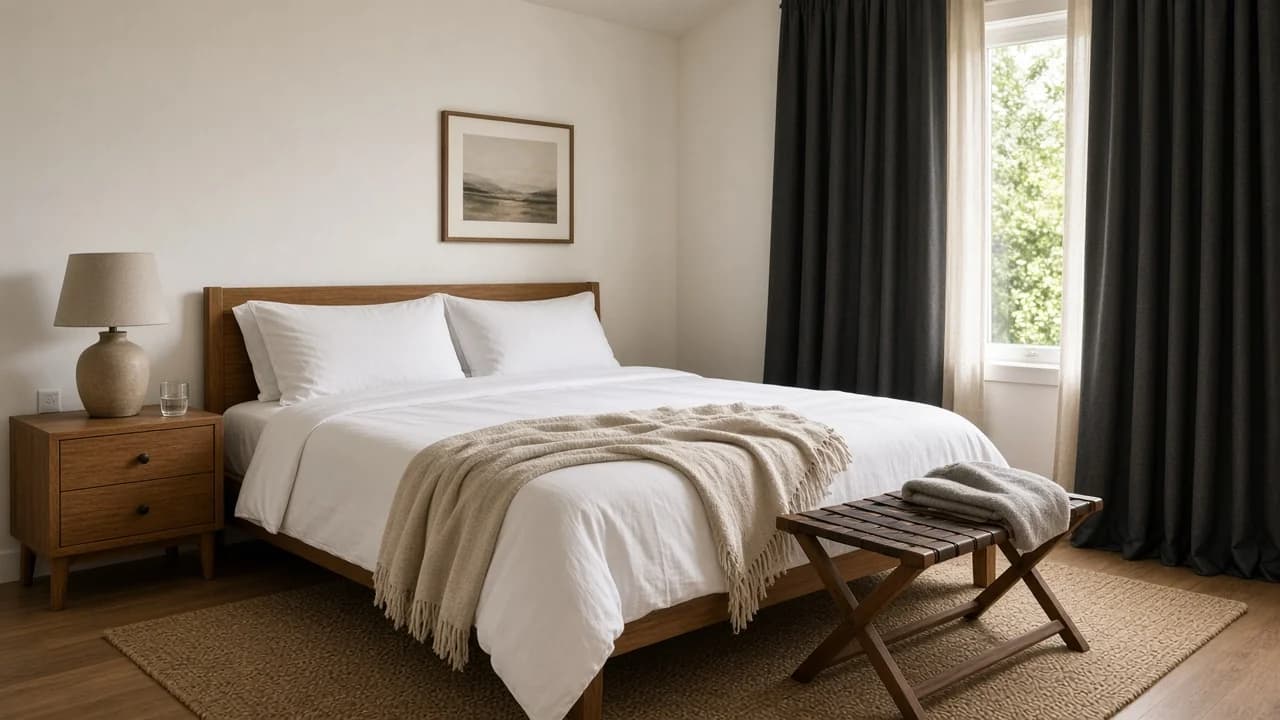

A dual-use guest room works when the sleep surface is real and the work gear has somewhere to go.
A guest room that doubles as an office rarely fails during the day. It fails at 10:40 p.m., when your sister-in-law is standing in the doorway holding a suitcase and there is nowhere to set it down. The desk is buried in paperwork and the sheets are still in the dryer. Nothing is broken — the room was simply never planned for the twelve hours when someone else lives in it. That is a planning problem, not a budget one.
Three things make a dual-use guest bedroom work: a sleep surface an adult can use for three nights without complaint, a reset you can finish in under fifteen minutes, and enough closed storage that your work gear disappears rather than gets tidied. Decide the bed type first — dedicated queen, daybed, sleeper sofa, wall bed, or cabinet bed — because every other choice in the room follows from it.
Start With the Overnight Test
Before you buy anything, spend one night in the room yourself, on the surface a guest would use, with the blinds and lamps exactly as they are. Not a nap — a full night, walking to the bathroom in the dark. You will learn more in eight hours than in a month of saving photos, and the fixes it turns up are usually cheap.
Dual-use rooms fail on the same handful of points. The mattress feels fine for twenty minutes and hollow by 3 a.m. No light can be switched off from the bed. The only reachable outlet sits behind the desk. And there is no surface for a suitcase, so it stays open on the floor and your guest spends four days bending down to it.
- Where does an open 22-inch carry-on sit without blocking the door or the walkway?
- Can your guest turn off every light without getting out of bed?
- Is there a free outlet within arm's reach of the pillow?
- Where do they hang a jacket, and where does a damp towel go?
- At 2 a.m., can they find the bathroom without an overhead light?
Pick the Bed Type First: Queen, Daybed, Sleeper, or Wall Bed
The bed decision is really a frequency decision. Count the nights a year the room hosts someone, then the days it has to work as an office or a hobby space. Above roughly twenty guest nights, buy a real bed and design the workspace around it. Below that, a bed that folds, rolls, or converts produces a better room for the other 345 days.
| Option | When it wins | Space it needs | Sleep quality | Reset time | Typical cost |
|---|---|---|---|---|---|
| Dedicated queen | 20+ guest nights a year; the room is a guest room first | 10 × 11 ft, with 24 in. beside the bed | Best — a real mattress on a real frame | 10 min (linens only) | $600–$2,000 frame + mattress |
| Twin daybed + trundle | Daily office or craft room; solo guests, kids, siblings | 42 × 80 in. against a wall, 30 in. to pull the trundle | Good, if you buy two real twin mattresses | 5 min | $300–$1,200 |
| Queen sleeper sofa | Room doubles as a den or media space; occasional couples | 90 in. of open projection; 34–38 in. deep closed | Weakest — thin mattress, a support bar you can feel | 5–10 min | $900–$3,000 |
| Queen wall bed (Murphy) | Full-time office that must host couples several times a year | 90+ in. of clear floor open; 16–18 in. deep closed | Very good — takes a 10–12 in. mattress | 3 min | $1,600–$4,500 installed |
| Cabinet bed | Renters, or no wall you can mount hardware to | About 70 × 22 in. closed; 85 in. open | Good — tri-fold mattress, 6–10 in. | 5 min | $1,500–$2,800 |
| Air mattress or floor futon | Fewer than three nights a year; cousins and kids | Any clear 60 × 80 in. of floor | Poor for adults past one night | 15 min, including finding the pump | $80–$300 |
Ranges reflect typical U.S. mid-market retail, not a quote. Installed wall bed pricing varies most by cabinetry.
Two things surprise people. Wall beds sound like the complicated option and are the easiest to reset, because the bedding stays strapped in place — you fold the room rather than remake it. Sleeper sofas are the cheapest queen surface to buy, and the one guests quietly dread.
Sleep Quality Matters Even If Guests Come Twice a Year
Guests judge a mattress in the first ninety seconds and never mention it again, which is exactly why it deserves the money. The usual failure is not a bad mattress so much as an old one — the hand-me-down innerspring from your first apartment, a decade past its support life. Press the center with your palm. If you feel springs or see a dip, good linen will not fix that night.
You do not need a premium mattress. A mid-range 10- to 12-inch foam or hybrid queen handles occasional guests well and ships compressed, which helps if the room is up a tight stairwell. If you are keeping a thin or firm surface — a daybed, a sleeper, a wall bed platform — a 2- to 3-inch topper is the highest-return money in the room. Pillows come next: two per sleeper, one medium and one firmer, replaced every couple of years, because they absorb the years even when the room sits empty.
Make the Office Disappear, Not Just Look Tidy
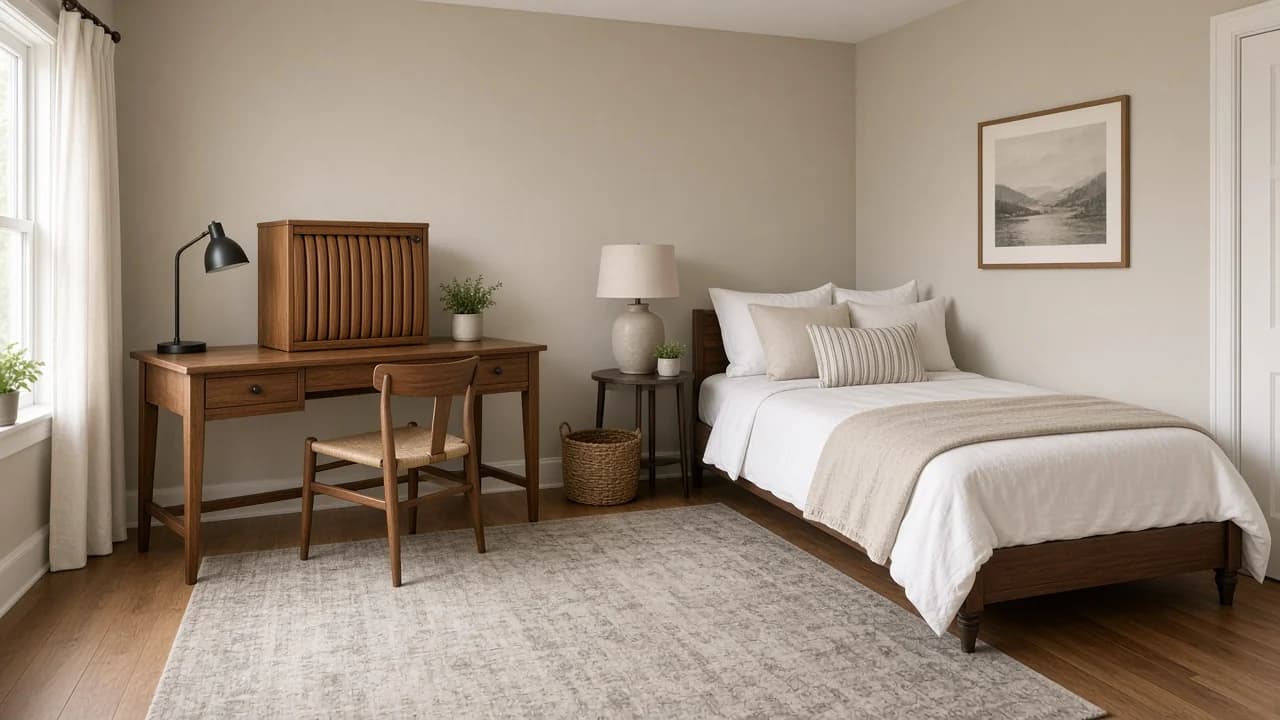
Tidying and hiding are different jobs. A neat stack of paperwork still tells your guest they are sleeping in your office, and there is still nowhere to put a glass of water. Aim for closed storage sized to swallow the whole desk surface in one motion, so the reset is a transfer, not a decision about each item.
- One deep drawer or lidded bin per project, so the reset is “sweep the desk into the bin,” not “sort the desk.”
- A desk that closes or rolls on locking casters, so the surface becomes a nightstand or leaves the walkway.
- A monitor on a swing arm, or a laptop that goes into the drawer with its dock.
- One power strip behind the desk, cables in a sleeve, and a second outlet kept free for guests.
- A lockable file drawer if you handle client records, medical paperwork, or tax documents.
- A wall shelf for the printer, not the spare chair a guest would use.
Hobby rooms need one extra rule: nothing sharp, wet, or fragile stays out. Needles, craft blades, resin, and open paint are what go wrong when a guest's kid wanders in before you are awake. One latching bin on a high shelf handles the category.
Storage and Luggage: Where the Suitcase Actually Goes
The common gap in guest rooms is not storage capacity — it is empty storage. Your guest will not move your winter sweaters aside to hang a shirt. They will live out of a suitcase on the floor and then tell you the room was lovely. Reserved emptiness is what makes a room feel unpackable.
| What guests need | Why it matters | Under $50 | Step up ($50–$250) |
|---|---|---|---|
| A suitcase landing | An open carry-on at hip height beats one on the floor for four days | Folding luggage rack | Upholstered storage bench, 18–20 in. deep |
| Hanging space | Wrinkled clothes are the complaint you will never hear about | Six to eight matching hangers on a reserved section of rod | Slim rolling garment rack or a wall-mounted rod |
| One genuinely empty drawer | Signals the room is theirs and lets them actually unpack | Clear out one existing dresser drawer | Two-drawer nightstand or a narrow three-drawer chest |
| A bedside surface | Water, phone, glasses, book — a stack of books is not a nightstand | Nightstand-height stool or crate | Small table with a drawer and an outlet or USB within reach |
| Towel and robe hooks | A damp towel has to go somewhere other than the bed | Two over-the-door hooks | Wall-mounted hooks plus a folding valet stand |
| Under-bed clearance | Empty suitcases need to live somewhere for a week | Risers to gain 9–10 in. of clearance | Frame with 12 in. of clearance, or built-in drawers |
The order matters more than the price. Buy top to bottom if you are spreading the cost over a few months.
If you buy one thing this month, buy the luggage rack or the bench. It costs less than a set of sheets and does the most to change how a guest moves through a small room.
Light, Dark, and the 2 a.m. Trip to the Bathroom
Light is where guest rooms fail most reliably, because you never sleep there and your eyes stopped registering the streetlight years ago. Blackout matters less as fabric than as installation: mount the rod about four inches above the frame and extend it 8 to 12 inches past each side, or use a ceiling-mounted track so light cannot spill around the edges.
Then hand over control. A guest should be able to switch off every light without standing up: a bedside lamp with a switch they can find in the dark, a warm bulb near 2700K, and 450 to 800 lumens for reading. Add a plug-in motion night light low on the wall along the route to the bathroom. Your guest is crossing an unfamiliar house at 2 a.m., past a step they do not know exists.
Layout Math for Small Guest Rooms
Small rooms need honest measurements more than clever furniture. Before you order, tape the open footprint on the floor — including a wall bed at full projection or a sleeper pulled out — then walk the room and open the closet. If you turn sideways to pass, the layout is not finished.
| Measurement | Minimum | Comfortable | Why it matters |
|---|---|---|---|
| Beside a bed used by one person | 24 in. | 30 in. | Room to make the bed and get in without climbing |
| Both sides of a bed used by a couple | 24 in. each side | 30 in. each side | Nobody should climb over anyone at 6 a.m. |
| Main walkway through the room | 30 in. | 36 in. | Someone carrying luggage needs more than one shoulder width |
| Projection of an open queen wall bed | 90 in. | 90 in. plus 30–36 in. to walk | A 16–18 in. cabinet plus an 80 in. mattress; measure wall to wall |
| In front of dresser or desk drawers | 36 in. | 40 in. | You have to stand in front of an open drawer, not beside it |
| Door and closet swing | Full arc clear | Full arc plus 12 in. | A daybed that blocks the closet door defeats the storage plan |
Measure to trim, baseboard, and radiators — not to bare drywall.
The other small-room rule: resist the oversized dresser. A 60-inch six-drawer piece eats the wall you needed for the bed and mostly stores things that could live elsewhere. A narrow chest, a two-drawer nightstand, and reserved closet space carry the same guest load in a third of the floor area.
The 15-Minute Pre-Arrival Reset
Once the furniture is right, hosting becomes a routine instead of a scramble. This is the reset I time in rooms I plan; if yours runs long, the storage is wrong, not the routine.
| Minutes | Task | What it fixes |
|---|---|---|
| 0–3 | Sweep the desk into its bin or drawer; roll the desk to the wall | Removes the “you are in my office” signal |
| 3–6 | Open the bed or remake it with linens stored in this room | No hunting through the hall closet for sheets |
| 6–9 | Empty one drawer, free six hangers, set out the luggage rack | Lets your guest actually unpack |
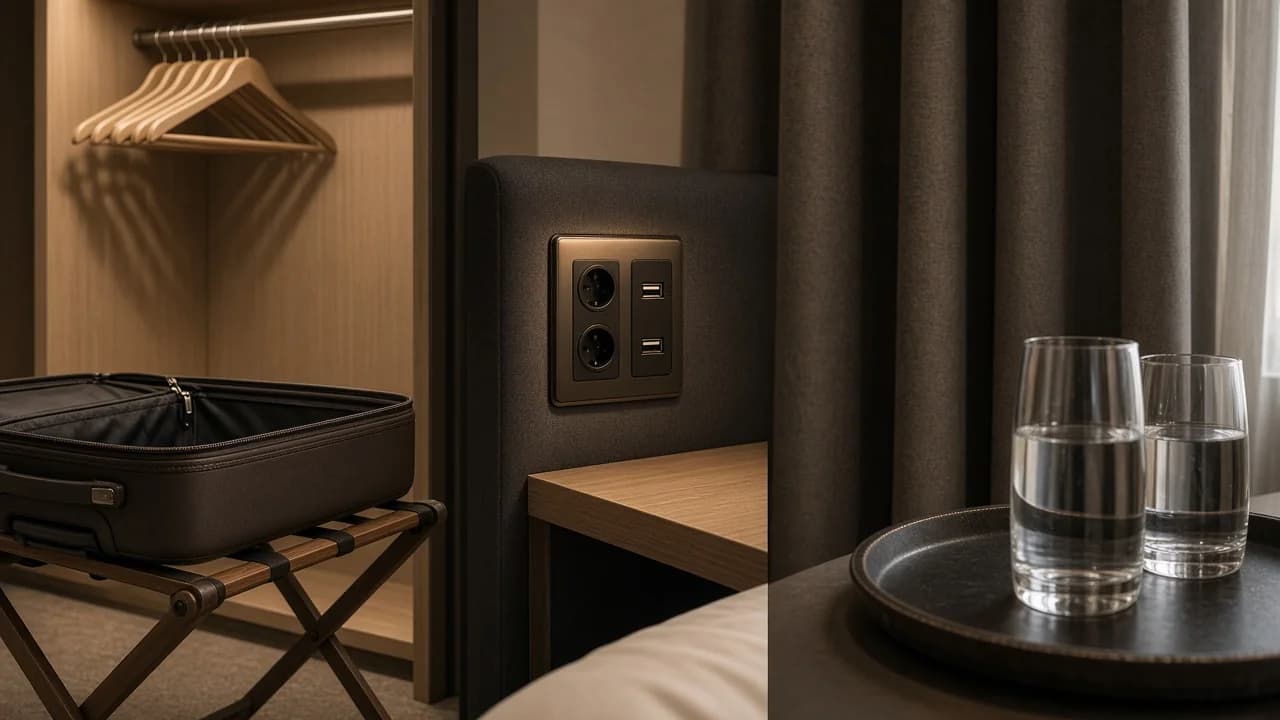
| 9–12 | Set the bedside tray: lamp, charger, water, tissues, Wi-Fi card | The details guests remember and repeat |
| 12–15 | Test blackout, the lamp switch, the night light, and the door latch | Catches the failures daylight hides |
Keep guest linens and towels inside the guest room. Walking to another closet is the biggest single delay in the reset.
- Water in a carafe or bottle, with a real glass, on the nightstand.
- A charging cable that stays in the room, in the connector your guests use.
- The Wi-Fi password on a card, not shouted from the kitchen.
- Two towels and a washcloth folded at the foot of the bed.
- A note listing where the bathroom, thermostat, and coffee are.
- An empty wastebasket and a spare roll of toilet paper.
What Guests Notice First
Across the dual-use rooms I have planned and revisited, guest comments cluster in a consistent order — close to the inverse of what people buy first.
- Temperature — too warm, too cold, or air that never moves.
- The mattress, judged within a minute of lying down.
- Whether there is anywhere to put the suitcase and the clothes.
- Light control: the sunrise, the hallway glow, the switch out of reach.
- Noise from the hallway, the HVAC, or the street.
- Whether the room feels like theirs for the night, or like your office wearing sheets.
Decorative headboards, matching furniture suites, and coordinated art appear nowhere on that list.
Common Mistakes in Dual-Use Guest Rooms
- Buying a bed for the holidays instead of the fifty weeks the room is an office.
- Keeping a mattress you would not sleep on, then compensating with expensive bedding.
- Ordering a 14-inch mattress for a wall bed rated for 10 to 12 inches.
- Filling every drawer and hanger, which leaves your guest living out of a suitcase.
- Skipping blackout because the curtains look nice, then apologizing about the sunrise.
- Leaving the only reachable outlet behind the desk.
- Adding a bench at the foot of the bed that blocks the closet door or the walkway.
- Leaving blades, paint, and client paperwork out because “they are only here two nights.”
The best compliment a guest room gets is that nobody could tell it was an office yesterday.
— Jordan Ellis, Rooms & Layout Editor
A good dual-use guest bedroom is not a smaller hotel room. It is a space that does your work five days a week and converts in the time it takes to fold laundry. Match the bed to how often you truly host, spend on the sleep surface and the light, keep one drawer and one stretch of rod genuinely empty, and the room will read as considered even on the night you are running late for the airport.
Frequently asked questions
What is the best bed for a guest room that doubles as an office?
For a room you work in daily, a queen wall bed (Murphy bed) is usually the best answer: it takes a real 10- to 12-inch mattress, folds away with the bedding still strapped in place, and gives the floor back to your desk. If you cannot mount hardware to a wall — in a rental, for example — a cabinet bed does the same job on a roughly 70 × 22 inch closed footprint. Choose a dedicated queen instead if the room hosts more than about twenty nights a year, and treat a sleeper sofa as the compromise it is.
How thick can a mattress be on a Murphy bed?
Most queen wall beds cap mattress thickness at 10 to 12 inches, and they also publish a weight range because the lift pistons or springs are balanced to it. A 14-inch pillow-top will keep the cabinet from closing flush, and forcing it puts strain on the mechanism. Cabinet beds are stricter still: they use tri-fold mattresses in the 6- to 10-inch range. Read the manufacturer's spec sheet before you shop for the mattress, not after.
Is a daybed or a sleeper sofa better for a guest room?
A daybed with a trundle is better for sleep and worse for lounging; a sleeper sofa is the reverse. Daybeds use two real twin mattresses, so an adult sleeps well and the reset takes about five minutes. Sleeper sofas offer a queen surface for couples but usually a thin mattress over a support bar that guests can feel. If you pick a sleeper, budget for a 3-inch topper and store it in the room so it actually gets used.
How much space do you need for a queen wall bed?
Plan for about 90 inches of projection from the wall when the bed is down — roughly a 16- to 18-inch cabinet plus an 80-inch mattress — plus 30 to 36 inches of walking space in front of it. That means a wall-to-wall dimension of at least 10 to 11 feet in the direction the bed opens. Measure to baseboard, trim, and any radiator, and tape the full open footprint on the floor before you order.
Do you really need blackout curtains in a guest room?
In almost every case, yes, because you are not the one sleeping there and you have stopped noticing your own streetlight. Blackout matters less as fabric and more as installation: mount the rod about four inches above the window frame and extend it 8 to 12 inches past each side, or use a ceiling-mounted track so light does not spill around the edges. A blackout roller shade behind a decorative curtain is the inexpensive version and outperforms either piece alone.
How do I make a guest room feel welcoming on a small budget?
Spend in this order: pillows, a mattress topper if the surface is thin, a luggage rack, blackout, then a bedside light and tray. Under about $200 total you can fix the four things guests actually judge — sleep surface, somewhere to put the suitcase, light control, and a place to set a glass of water. Matching furniture suites and decorative headboards change the photograph, not the night.
Where should guests put their suitcase?
At roughly hip height, off the floor, and out of the walkway. A folding luggage rack costs less than a set of sheets and is the single object that most changes how a guest moves through a small room; an 18- to 20-inch-deep storage bench does the same job and looks permanent. Also leave 9 to 10 inches of clearance under the bed so an empty carry-on has somewhere to live for the week.
How often should I replace a guest room mattress and pillows?
Pillows every two to three years, even if the room sat empty, because foam and down compress with time as well as use. Mattresses last 7 to 10 years, but judge by feel rather than the calendar: press the center with your palm, and if you feel springs or see a visible dip, it is done. A mattress stored in a closed room does not age well — rotate it two or three times a year so the surface stays even between visits.
Related guides
- How to Pair a Mattress with the Right Bed Frame
A warranty-safe pairing guide for U.S. bedrooms — platform vs box spring vs foundation, slat spacing by mattress type, storage-bed airflow, adjustable bases, bunkie boards, and nightstand height that actually matches the mattress top.
- Desk Height Ergonomics: Ideal Height, Chair Fit & Monitor Setup
A practical home-office ergonomics guide — find your ideal desk height from elbow height, fix a standard 29–30 inch desk, set chair and monitor position, and use sit-stand wisely.
- Small Apartment Furniture: What Actually Fits
A clearance-first furniture guide for U.S. studios and one-bedrooms — sofa width and depth, 30–36 inch walkways, round tables, elevator limits, and the pieces that earn their footprint.
- guest bedroom ideas
- dual-use guest room
- Murphy bed
- daybed
- sleeper sofa
- cabinet bed
- blackout curtains
- luggage storage
- guest room checklist
- small guest bedroom layout