Guide · 12 min read
How to Pair a Mattress with the Right Bed Frame
A warranty-safe pairing guide for U.S. bedrooms — platform vs box spring vs foundation, slat spacing by mattress type, storage-bed airflow, adjustable bases, bunkie boards, and nightstand height that actually matches the mattress top.


The mattress is only half the purchase. What sits under it decides feel, lifespan, and whether a warranty claim survives a photo review.
Buying a mattress without deciding what goes under it is how people end up with a wavy sleep surface, a denied warranty claim, and a nightstand that sits somewhere near their shin. The pain is specific: the bed feels softer (or softer in the middle) than it did in the showroom, the foam starts showing ribbed impressions over wide slats, or a claim photo of a sagging center rail kills the case before anyone talks about manufacturing defects.
For almost every foam, latex, and hybrid mattress sold in the U.S. today, pair it with a rigid foundation or a platform bed with slats about 2.75–3 inches apart (or tighter if your warranty says so), plus real center support on queen and larger. Skip traditional coil box springs unless your innerspring warranty explicitly wants one. Fix wide gaps with extra slats or a bunkie board before night one — not after the first permanent dip.
Mattress, Foundation, Frame, and Bunkie Board — What Each Piece Does
Retail language mixes these terms until shoppers buy the wrong stack. Mattress makers and bed-frame reviewers keep returning to the same hierarchy: the frame is the structure you see (rails, headboard mounts, legs). The foundation or platform is the continuous support surface the mattress sits on. A bunkie board is a thin overlay that closes gaps. A traditional box spring is a springy underlayer — not a synonym for “anything under the mattress,” even though sales floors still default to that phrase.
Mattress-store educators (including long-form explainers that tear open box springs next to wood foundations) put it bluntly: a mattress is only as good as the weakest link underneath it. Wrong support can void the warranty, damage the core, and eventually show up as back pain. Flooring that dips under a center leg can sabotage an otherwise correct foundation — so the stack starts at the floor, not at the law tag.
- Bed frame — rails, legs, optional headboard/footboard; may or may not include a support deck.
- Platform bed — frame with built-in slats or a solid deck; usually replaces a separate foundation.
- Foundation (wood foundation / flat foundation) — rigid, non-spring support; common warranty match for foam and hybrids.
- Box spring — coil or wire grid with flex; mainly for older innerspring “sets,” not modern foam.
- Bunkie board — thin solid/nearly solid panel that sits on existing slats to meet gap rules.
- Adjustable base — motorized platform; needs a flexible, labeled-compatible mattress.
Mattress Type → Best Support Pairing
Match the chemistry of the mattress to the stiffness of the base. Foam and latex want a flat plane. Hybrids usually want the same rigid plane even though coils live inside. Traditional connected-coil innersprings are the one family that sometimes still “expects” a box spring — and even then, many current warranties have moved to rigid foundations.
| Mattress type | Best support | Avoid | Notes |
|---|---|---|---|
| All-foam / memory foam | Solid deck or slats ≤2.75–3 in. | Traditional box spring; wide euro-slats | Most sensitive to gaps; foam can impress into openings |
| Latex | Solid deck or ≤2.75 in. slats | Flexing box springs; sparse slats | Often the strictest spacing language in warranties |
| Hybrid (foam + pocket coils) | Rigid foundation or ≤3–4 in. slats | Soft coil box springs under warranty bans | Still photograph center support on queen+ |
| Traditional innerspring | Check warranty; some allow box spring sets | Assuming any base is fine | Older thin coil beds used box springs as comfort layers |
| Adjustable-compatible foam/hybrid | Adjustable base rated for mattress weight | Rigid border-wire innersprings | Look for “adjustable base compatible” on the label |
Brand examples vary: Nest Bedding cites ≤4 in. slats with center support on queen+; Avocado cites ≤3 in. and discourages traditional box springs; Simmons Beautyrest docs commonly require ≤2 in. gaps or a solid platform overlay.
Slat Spacing Rules That Survive a Warranty Photo
Slat gap is the detail people skip and claims departments do not. Industry write-ups and brand warranties converge around a practical rule of thumb: keep openings near 3 inches or less for most foam and hybrids, tighter for latex-heavy builds. Some manufacturers still allow up to about 4 inches; a minority publish stricter two-inch limits unless you add a solid platform. There is no single federal “industry standard,” which is why cheap frames with 6–10 inch gaps still ship — and why cardboard-covered sparse foundations eventually warp into a wavy mattress surface.
Mattress-store educators who demo the failure mode make it visceral: set a pocket-coil unit on a platform with slats too far apart and individual springs drop straight through the openings. Over months of sleep, foam above those unsupported zones wears faster, can tear at the edges of the gaps, and leaves ribbed body impressions that look like a defect but trace back to the frame. That is why Tempur-Pedic bans box springs outright, Simmons Beautyrest requires a solid overlay when gaps exceed 2 inches, and Sealy asks for slats at least 3 inches wide and under 4 inches apart — the warranty language is describing the same physics you can see with a tape measure in five minutes.
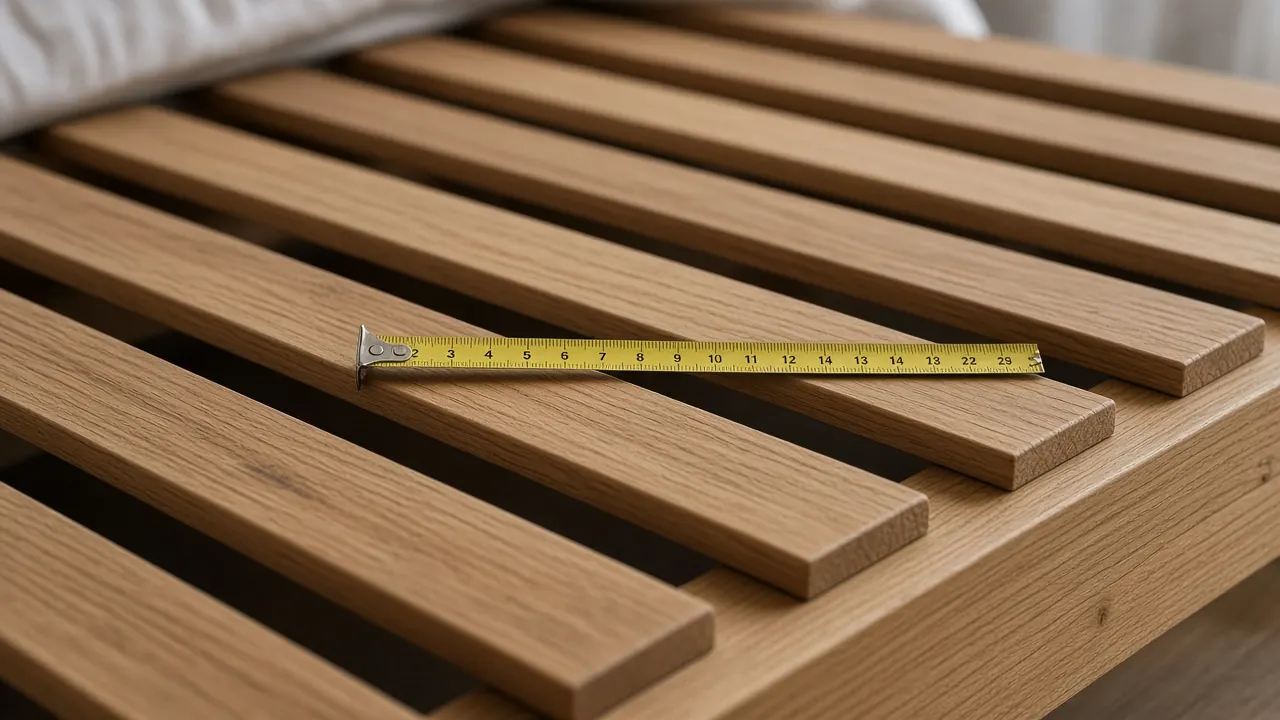
| Situation | Target gap | If you miss it |
|---|---|---|
| All-foam or latex (unknown brand) | ≤2.75 in. or solid | Add slats or bunkie board |
| Most hybrids / general warranty language | ≤3 in. | Add slats; re-check center legs |
| Brand allows up to 4 in. (e.g. some Nest language) | ≤4 in. + center support | Still prefer ≤3 in. for longevity |
| Strict brand (e.g. some Simmons docs) | ≤2 in. or solid overlay | Bunkie board / solid platform required |
| Queen / King / Cal King any brand | Gap rule + floor-touching center support | Fix hammocking before blaming the foam |
Platform Bed vs Box Spring vs Wood Foundation
A platform bed with dense slats is usually the cleanest modern answer: one purchase, no separate “box,” under-bed storage space, and a feel that matches how online mattresses were designed. Metal “smart base” style platforms marketed as box-spring replacements can work when the grid is tight and the legs share load — but treat marketing photos carefully; walk-on point loads and sparse wire decks are not the same as a hardwood foundation with close slats.
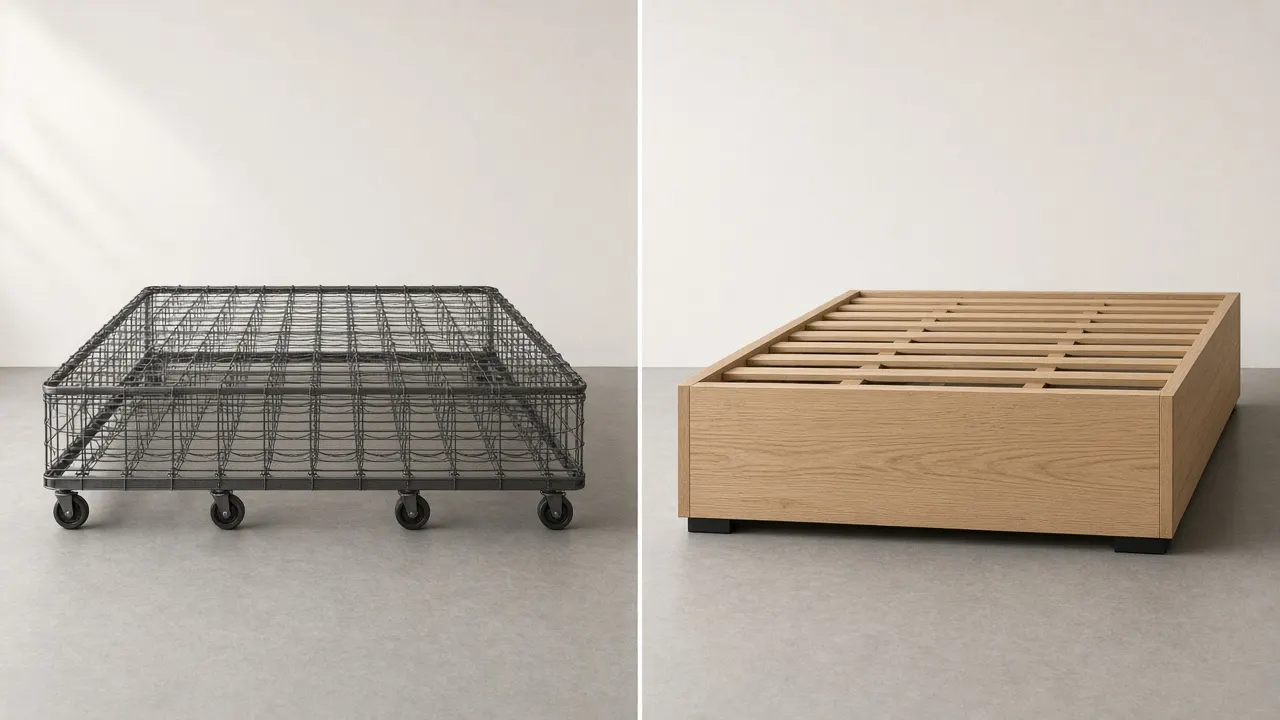
Traditional coil box springs still exist, especially in higher-end innerspring “sets.” Mattress Clarity’s breakdown — and the tear-down videos mattress stores still run — show why: old-school coil boxes absorb shock when both the mattress and base contain springs, add height, and keep airflow moving. That pairing made sense when mattresses were thin spring-and-cotton sandwiches. Modern foam, latex, and hybrid stacks already carry their own comfort layers; adding a flexing coil grid underneath creates uneven contact (coil tops with air gaps between) and can change firmness in ways the showroom never showed. Semi-flex wire foundations sit between true coil boxes and all-wood foundations: stronger, less give, still not what most foam warranties want.
Wood foundations are not equal either. Sparse-slat frames topped with cardboard can look fine for a year, then warp. Better builds skip cardboard filler, run denser hardwood slats, and stay quiet. If a listing only shows a fabric-covered rectangle and never discloses slat count or spacing, assume you will measure it yourself before the mattress goes on.
- Choose the mattress type and read its foundation clause.
- Decide platform (integrated deck) vs frame + separate foundation.
- Reject traditional coil boxes for foam/latex/hybrid unless the warranty blesses them.
- Measure slat gaps and center support; add a bunkie board only to fix gaps, not broken rails.
- Set total bed height, then buy nightstands to the mattress top — not to a catalog average.
Storage Beds, Airflow, and Moisture
Storage beds earn their footprint in apartments and guest rooms, but a sealed solid pan under a foam mattress can trap sweat and humidity. Sleep and home editors keep flagging the same failure mode: under-bed bins pressed tight to the underside, especially plastic totes, block the airflow foam needs to dry. Prefer slatted or ventilated storage decks, fabric breathable bags over airtight boxes when you must store under the bed, and a habit of pulling drawers to vacuum and air the cavity a few times a year.

Adjustable Bases and Total Bed Height
Adjustable bases need mattresses that bend: memory foam, latex, and pocketed-coil hybrids marked compatible. Connected-coil innersprings and rigid edge systems fight the motors and can fail early. Many setup guides land in an 8–14 inch mattress thickness band for clean articulation. Bases can stand alone or sit inside a frame designed for them — confirm clearance so the mechanism does not bind on side rails.
Total sleeping height is mattress thickness plus base height. Comfortable get-in/get-out height for many adults lands near 25–30 inches from floor to mattress top. A thick hybrid on a standard foundation can overshoot that; a thin mattress on a low platform can undershoot it. Nightstands follow the mattress top: measure floor-to-top, then choose a surface within roughly 2 inches below to 4 inches above. Standard 24–28 inch nightstands were built for older, lower beds — they look “fine” in product photos and feel wrong next to a 14-inch hybrid on a tall base.
| Setup | Typical add-on height | Watch-outs |
|---|---|---|
| Low platform / no-leg frame | ≈4–6 in. | May need shorter nightstands |
| Standard-leg platform | ≈9–12 in. | Common modern default |
| Low-profile foundation in a frame | ≈4–5 in. | Good when mattress is already tall |
| Standard foundation in a frame | ≈8–9 in. | Easy to create a high bed |
| Standalone adjustable base | ≈12–14 in. | Confirm mattress is flexible/compatible |
Headboard Mounts and Delivery-Day Pairing Checks
Pairing is not only vertical support. Confirm whether your headboard attaches to the frame, the foundation, or the wall. Hook-on frames and bolt-on metal rails are not interchangeable with every wood platform. If the mattress and frame ship separately, treat delivery like any other furniture drop: count cartons, photograph packaging, and inspect the foundation for cracked rails or bent center legs before the old bed leaves the room. A damaged center support is a warranty problem waiting for the first humidity swing.
What to Do When Your Current Frame Is Wrong
You do not always need a new bed. Closing gaps is usually cheaper than replacing a mattress that has already started to imprint. Add 1×4 hardwood slats to bring openings under your warranty limit, drop in a bunkie board for a continuous surface, or replace only the foundation while keeping a headboard you like. Replace the whole frame when legs wobble, the center rail bows, or euro-slats flex under sitting weight — those are structural failures, not spacing oversights.
- Gaps too wide → extra slats or bunkie board ($20–$120 range for most DIY fixes).
- Queen hammocking → center rail + legs that touch the floor (non-negotiable).
- Squeaks on cardboard foundations → denser wood-slat foundation without cardboard filler.
- Want motion positions → switch to an adjustable-compatible mattress + rated base together.
- Moving soon → prioritize foldable or tool-light platforms, but still verify slat spacing in the listing specs.
Pair the mattress and the support as one system, then finish the room: nightstand height to the mattress top, lamps that clear the headboard, and a delivery path that fits the boxed foundation. That is how a bedroom purchase stays comfortable past the trial window — and how a warranty claim, if you ever need one, starts with evidence instead of excuses.
Frequently asked questions
Do you need a box spring with a modern mattress?
Usually no. Memory foam, latex, and most hybrids sold for U.S. homes in 2026 are engineered for a rigid foundation or a platform bed with closely spaced slats — not a traditional springy box spring. A box spring can add unwanted flex, change firmness, and void warranties that require a solid, non-yielding surface. The main exception is an older innerspring specifically built for a box spring set; check that model’s warranty card.
What slat spacing does a mattress warranty require?
Most brands require slats about 3 inches apart or closer; some foam and latex lines prefer 2.75 inches or a solid deck. A few warranties are stricter (Simmons Beautyrest documentation commonly cites 2 inches or less without a solid platform overlay) while others allow up to about 4 inches. Always follow your specific warranty — manufacturers often request foundation photos during claims.
What is the difference between a box spring and a foundation?
A traditional box spring uses metal coils or wire grids that flex under load. A foundation is a rigid wood (or wood-and-steel) support with no springs — often a wood frame with dense slats. Retail staff still say “box spring” as a catch-all, but the insides are different: flex vs flat, springy vs solid. For foam and hybrids, the rigid foundation is almost always the correct match.
Do I need a bunkie board on a platform bed?
Only if your slat gaps exceed your mattress warranty limit or the slats feel springy. A bunkie board is a thin (about 1–2 inch) solid or nearly solid panel that sits on existing slats to create a continuous surface without adding much height. It is a fix for wide-gap frames — not a substitute for broken center support on a queen or king.
Can I put a mattress on a storage bed?
Yes, if the deck is firm, flat, and warranty-compliant. Prefer storage beds with slatted or ventilated platforms so moisture can escape; fully sealed solid pans plus humid climates or night sweats raise mold risk under foam mattresses. Keep under-bed drawers dry, avoid airtight plastic bins stuffed against the underside, and air the cavity periodically.
What mattresses work with an adjustable base?
Memory foam, latex, and pocketed-coil hybrids labeled adjustable-base compatible. Avoid rigid connected-coil innersprings and mattresses with hard border wires or built-in rigid boards that cannot bend. Thickness in the roughly 8–14 inch range is common for smooth articulation. Using a non-compatible mattress can damage coils and void coverage.
How high should a nightstand be relative to the mattress?
Measure from the floor to the top of the mattress (including any topper). Aim for a nightstand surface roughly level with that height, or within about 2 inches below to 4 inches above — many designers treat flush-to-slightly-higher as the most comfortable reach. Modern thick hybrids on tall bases often need 28–30 inch nightstands; low platforms need shorter ones.
Will sleeping on the floor void a mattress warranty?
Often yes. Floor placement blocks airflow, traps moisture, and fails most “proper foundation” clauses. Brands such as Avocado explicitly state floor use can void coverage. If you need a temporary setup, use a low-profile foundation or platform that still elevates and ventilates the mattress.
- mattress and bed frame pairing
- do you need a box spring
- platform bed vs box spring
- mattress foundation
- mattress slat spacing
- bunkie board
- storage bed mattress
- adjustable base mattress
- nightstand height
- mattress warranty foundation
Related guides
- Furniture Delivery Day Checklist: What to Inspect Before You Sign
A field checklist for U.S. furniture delivery day — service levels from curb to white-glove, ROC explained, inspection steps before you sign, and how to protect a damage claim.
- Small Apartment Furniture: What Actually Fits
A clearance-first furniture guide for U.S. studios and one-bedrooms — sofa width and depth, 30–36 inch walkways, round tables, elevator limits, and the pieces that earn their footprint.
- What Size Rug Under a Sofa and Dining Table
A furniture-first rug size guide for U.S. homes — front legs vs all legs, 8x10 vs 9x12, the 24-inch dining chair rule, and the inch math that keeps a 5x8 from looking like a bath mat.