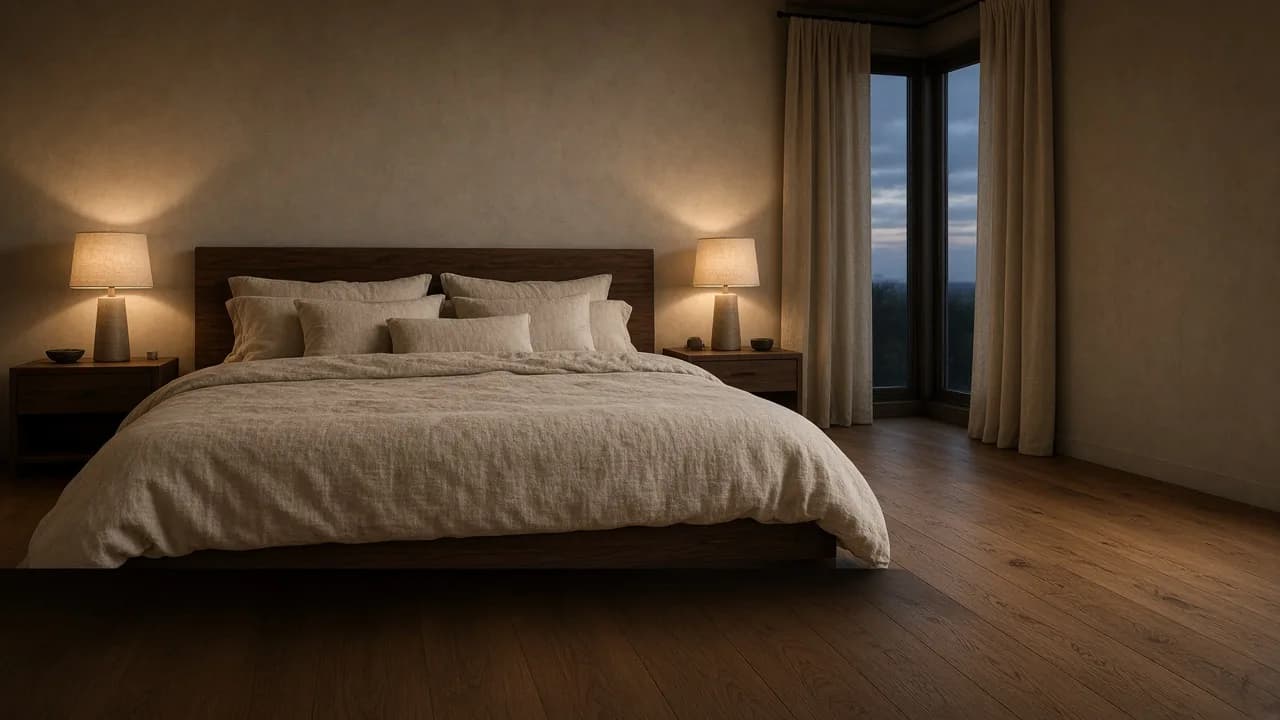

The path beside the mattress is the layout. The lamps are the last decision.
The king fit the listing. It does not fit the morning. One of you climbs over the other because the nightstand ate the side that looked generous on the floor plan. The dresser drawer hits the duvet. The bench you added to finish the photo now lives in the path to the closet. A matching set did not cause this. A missing tape measure did.
Measure from the mattress edge to the wall on each side two people use. Under 24 inches, the bed is too big for the room. Set the nightstand top within about 2 inches of the finished mattress, leave 2 to 6 inches between table and frame, and keep about 36 inches in front of an open dresser. A bench only earns its place if 36 to 42 inches remain after it.
How Much Space You Need Beside the Bed
Julie Jones, a certified interior designer, names the first mistake plainly: do not park the long side of a shared bed against a wall. That person climbs over their partner, and changing the sheets becomes a crawl. Her minimum is 24 inches on both sides, full or king, because it is about two people moving, not the mattress tag. Miss it on a side you use, and the bed is too big. Her only exception is a child’s room. Nina Takesh, in square suites of about 12 by 12 to 15 by 15, centers the bed on the wall without a window and holds 30 inches a side. The corner is not a space-saving trick.
Homes & Gardens, March 2025, puts the same band in designer language. Izabela Tokarski of Kabela & Co. asks for 24 to 30 inches on a queen and 30 to 36 on a king, with 36 to 42 at the foot of a king. Kristin Farnan wants the nightstand within 6 inches, an easy reach for water. Twenty-four beside the mattress is the floor. Thirty to 36 is what a king feels like when the room can spend it.
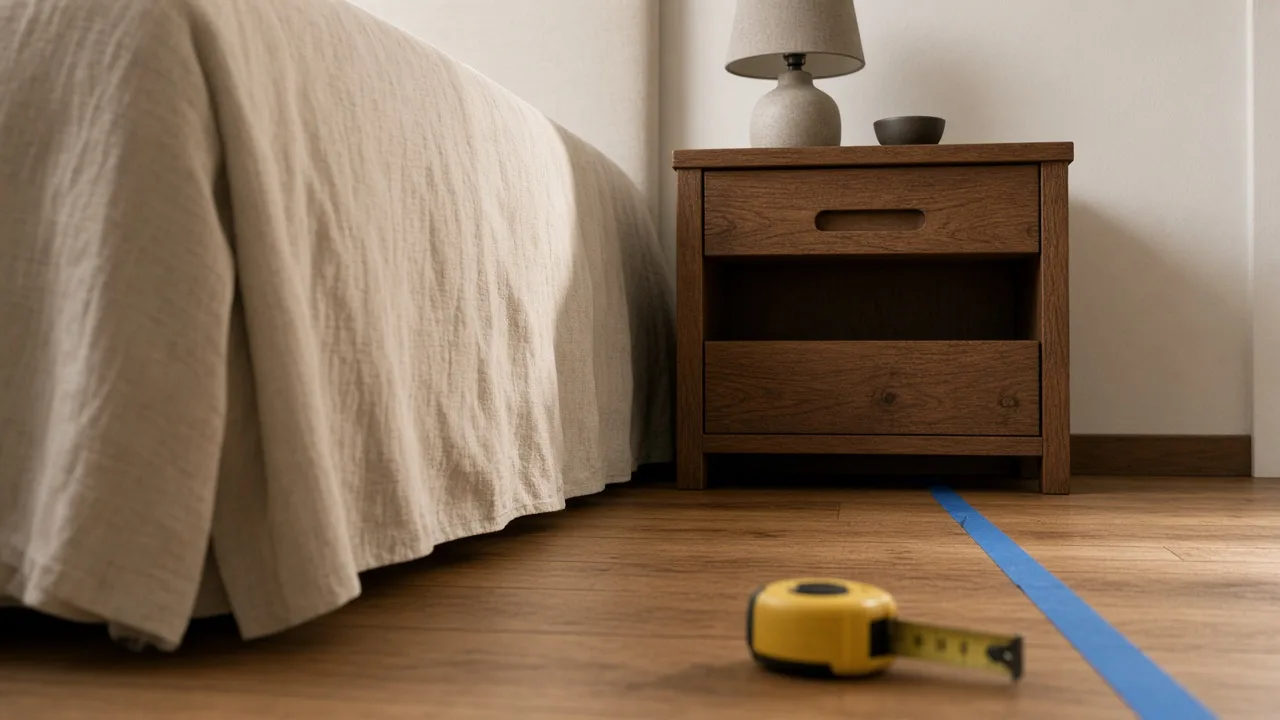
The trap is where the 24 inches is measured. It runs from the mattress edge to the wall, and the nightstand lives inside it. A 22-inch table in a 24-inch gap leaves a crack. Tables are usually 16 to 20 inches deep, so they only pinch the first foot and a half of the bed. You can step out farther down the mattress. You cannot walk behind the table. If you must pass it, the gap has to be the table’s width plus about 18 inches. Tape that before you order.
| Gap | Target | When it fails |
|---|---|---|
| Beside the mattress, shared side | 24 in. minimum; 30–36 in. for a king if the room allows | One person climbs over the other |
| Past a nightstand at the head | Table width plus about 18 in. if you must pass it | A 22-in. table in a 24-in. gap |
| Nightstand to bed frame | 2–6 in. | Bedding will not tuck; the drawer hits the rail |
| Foot of bed to a path | 24 in. subtracted before any piece | Dresser depth was planned on the full gap |
| In front of an open dresser | About 36 in. | Drawer hits the duvet; you dress in the hall |
| Hinged closet door | About 36 in. so someone can pass | Dresser sits in the morning swing |
| Foot of bed to seating | 36–42 in. | Bench plus dresser share one gap |
Twenty-four inches beside the mattress is the couple’s floor, from Julie Jones. King-side and foot ranges from Izabela Tokarski line up with it when the room is large enough to spend the extra inches.
What Size Room a King Actually Needs
A queen mattress is 60 by 80 inches. A king is 76 by 80. A California king is 72 by 84. A simple frame adds about 2 to 4 inches of width, so plan a queen near 64 inches and a king near 80. A queen plus two 22-inch nightstands and a 3-inch gap each side needs about 9 feet 6 inches of clear wall. A king with the same tables needs about 11 feet. That is the furniture line, not a walk. A wrapped headboard spends wall the mattress tag never mentioned.
Julie Jones prefers a queen on at least a 10-foot wall and a king on at least 12, closet left out of the count. A 10-foot wall is 120 inches. An 80-inch king frame leaves 20 inches a side and fails 24 inches before a nightstand arrives. A 12-foot wall leaves 32 inches a side. You can get out of bed. A 22-inch table leaves about 10 inches to pass at the head. She has seen a king in a 7-foot alcove, entry only from the foot. The fix was a queen, and even then only one side got 2 feet.
Fourteen feet is the width that stops the argument. One hundred sixty-eight inches minus an 80-inch king leaves about 44 inches a side, so a 22-inch nightstand still leaves a walk. A primary that wants a king, two tables, and a dresser without a daily sidestep lands near 14 by 16, not the 12-by-12 that “fits a king” on a listing. Own the 12-foot room already, and buy a queen, or one slim table and a shelf. A California king is narrower, 72 inches, and longer, 84. It can save a failed king wall and steal the foot clearance the dresser was counting on.
| Wall width | Queen, ~64 in. frame | King, ~80 in. frame |
|---|---|---|
| 10 ft (120 in.) | About 28 in. a side. Clears 24 in. Nightstand leaves a tight pass. | About 20 in. a side. Fails 24 in. before the tables. |
| 12 ft (144 in.) | About 40 in. a side. Room to pass a 22-in. table. | About 32 in. a side. You get out of bed. Passing the table is a squeeze. |
| 14 ft (168 in.) | Generous. Do not fill it with a wider bed you do not need. | About 44 in. a side. A 22-in. table still leaves a walk. |
| Furniture line only | About 9 ft 6 in. for frame, two tables, and gaps | About 11 ft for frame, two tables, and gaps |
Side inches are mattress-edge to side wall, nightstand included. Frame widths vary. Measure the piece you are ordering. A wrapped headboard spends more wall than the mattress.
Where the Bed Goes When the Room Has Four Doors
Most primaries have an entry, a bath, and a closet. Nina Takesh’s rule is the longest uninterrupted wall. That is the bed wall. A bay is a seat, not a headboard niche — keep at least 36 inches from the foot of the bed to where the bay begins. In a long, narrow room, put the bed parallel to the short wall. She holds 30 inches to the side walls and about 36 inches of path down the room. Seating at the foot needs at least 42 inches, or the chair and the bed argue.
You should see the bedroom door from the pillows, and you should not be lined up with it. Julie Jones moved a client off a wall that centered the bed on double doors. The plan looked balanced. The room felt like a display. Do not aim the headboard at the toilet either. Night use throws light at the pillows. If you cannot change walls, increase the distance and break the alignment.
If the bedroom has one window and no door to the outside, a bed or a tall dresser across that window blocks the escape route. The International Residential Code keeps the bottom of a required emergency opening no more than 44 inches above the floor, and the window has to open from inside without a key or a tool. A headboard under glass can look right. It is the wrong wall when that glass is the only way out. Several windows, and the issue mostly goes away.
Nightstand Height, Measured After the Topper
The nightstand top should sit level with the mattress, or within about 2 inches of it. Measure after the frame, the mattress, and the topper are stacked. A platform spec of 18 inches is meaningless once a 12-inch mattress and a 2-inch topper land on it. A finished height near 26 inches wants a table around 24 to 28. Leave 2 to 6 inches to the frame. Width is whatever the side gap can spare, usually 18 to 24 inches. Shea McGee starts with the bed, then one connection between nightstand and dresser — a wood, a finish, a line — and different legs. McGee & Co. adds: if the tables differ, keep the lamps at one height.
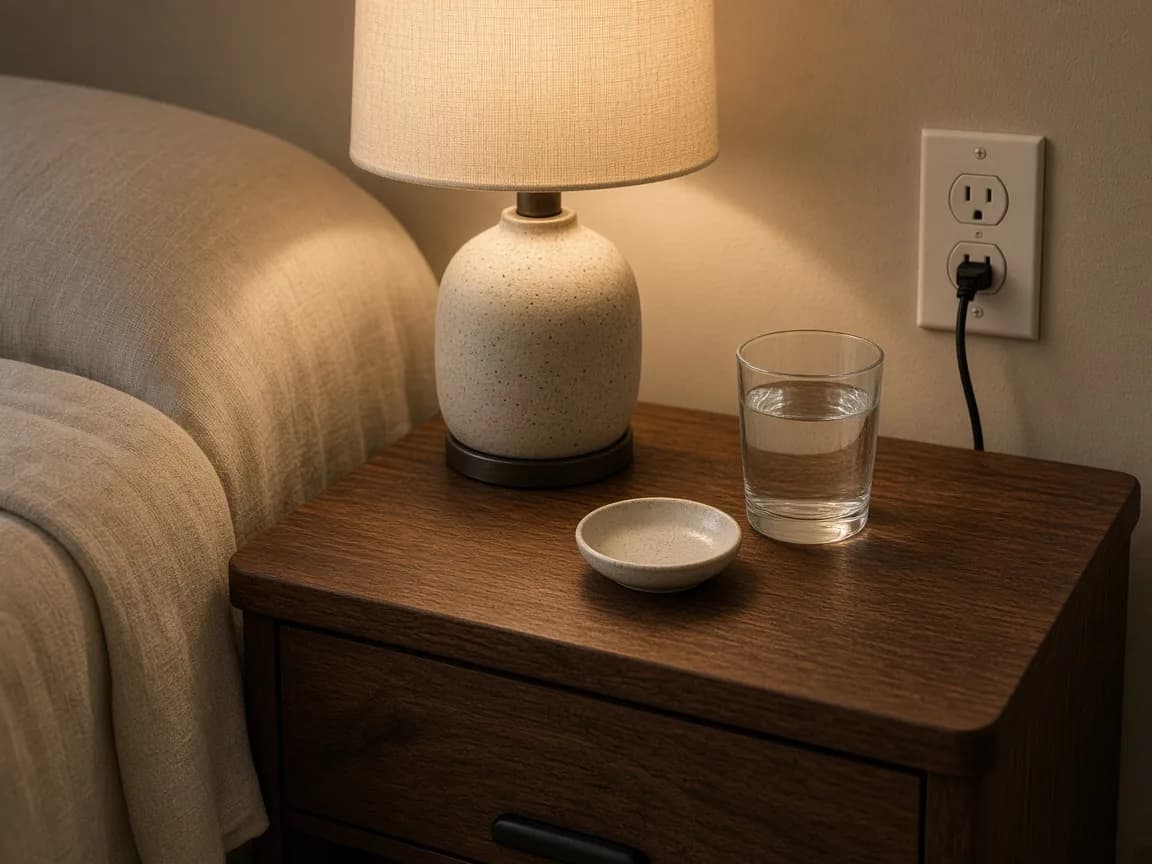
A small primary needs a surface for the phone, the water, and the glasses, not a twin of the other side. Julie Khuu will use a slim table, a wall-hung shelf about 10 to 12 inches deep, or a deep windowsill if you have one. Swing-arm sconces free the top when a lamp and a glass will not both fit. One shelf on the tight side beats two identical tables that erase the path.
The outlet is why so many nightstands sit off the wall. In a dwelling, receptacles are spaced so you are never more than 6 feet from one along the wall, which is why a duplex lands behind the table. The charger brick hits the back panel and the table leans forward. Plan a receptacle at about mattress height in that zone, or a USB there, before the headboard goes up.
Dresser Clearance, the Closet Door, and the Bench
Julie Khuu’s dresser method is the one to tape on the floor. Measure from the foot of the bed to the opposite wall, subtract 24 inches of path, and what remains is the depth you can buy. Typical drawers project 16 to 22 inches. Standing in front of an open one wants about 36 inches in front of the closed case, or you dress sideways. Closed depth on a spec sheet is not the operating footprint.
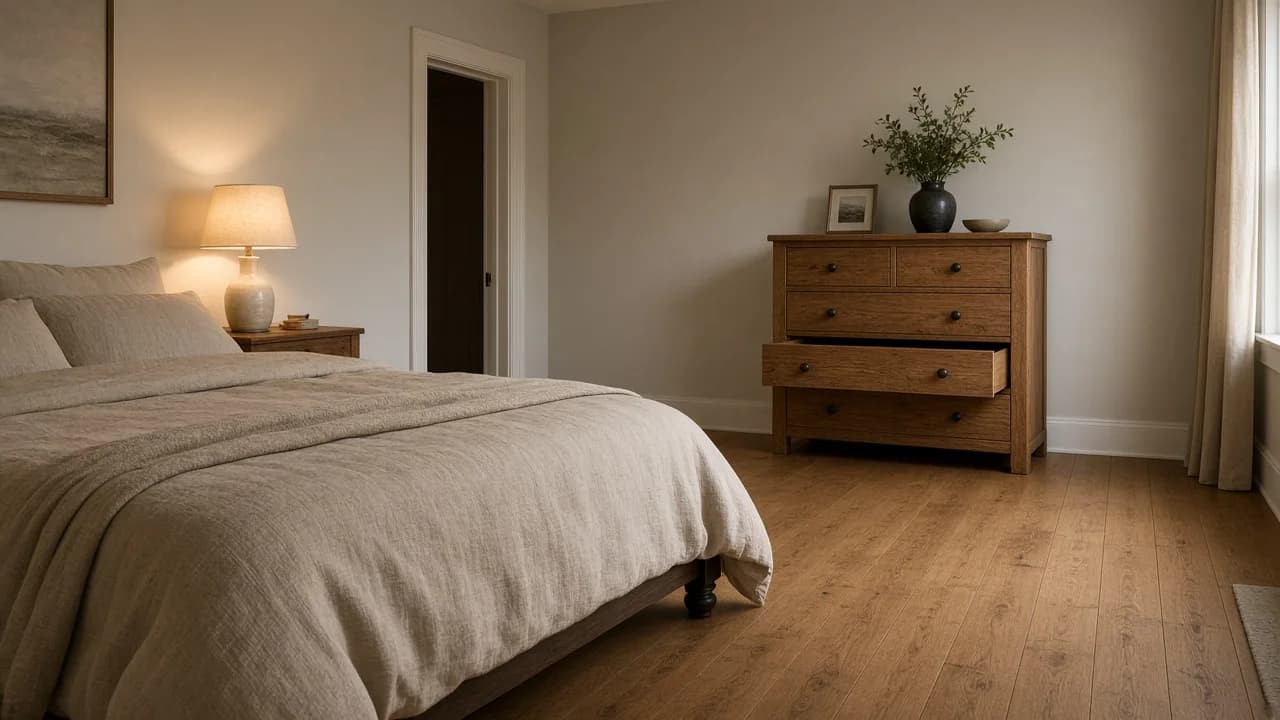
Farnan wants about 36 inches in front of a hinged closet door so someone can walk behind you. Sliding doors can live with 24 to 30 inches. A dresser in that swing is the piece you move the first week. The bench is the next delete. Nina wants at least 42 inches from the foot of the bed to seating. If the bench and the dresser share one gap, the bench loses. Shea McGee uses two small ottomans when a full bench will not fit.
Rug, Lamps, and a TV You Can Watch from the Pillows
Julie Jones sizes a bedroom rug by where your feet land: about 2 feet past each side you step out of, and 2 feet at the foot. A queen is 60 inches wide, so two feet each side is a 9-foot rug. An 8x10 leaves about 18 inches a side. A 7x9 leaves about 12. A king is 76 inches wide, so a 9-foot rug leaves about 16. Shea McGee pulls the rug forward so the nightstands are not half on it. A table rocking on the rug edge is a placement error.
A lamp on each side, or a swing-arm one person can aim at a page, beats one overhead can after 10 p.m. Bulbs near 2700K, shade bottom near eye height when you are propped. Do not copy the living-room TV height. A sofa often wants the screen center near 42 inches off the floor. In bed you are reclined. Measure eye height on the pillows you use, and tilt the set if the dresser forces it up. Eight to 12 feet to the opposite wall is a 55 or a 65, not a 75 over the drawer zone. Do not hang it over the only escape window.
- Tape both sides of the mattress. Under 24 inches on a side you use, buy a smaller bed.
- Longest clear wall first. Check the door sightline and the toilet before you pick a headboard.
- Nightstand height to the finished mattress. Width that does not erase the side gap.
- Subtract 24 inches at the foot, then buy dresser depth. Hold about 36 inches for an open drawer.
- Bench only if 36 to 42 inches remain. Otherwise leave the floor.
- Rug past the mattress, more at the foot, not half under the tables.
- Measure the doorway, the stair landing, and the elevator before the frame ships.
Delivery is part of the layout. A king that clears 24 inches in the room still fails if the box will not turn the landing. Write the frame width, the door width, and the side-gap numbers on the same page, and check the pairing guide if the mattress needs a stated slat spacing or an approved foundation.
A primary bedroom is finished when both of you can get up without a negotiation and you can open a drawer without turning sideways. The headboard finish is the last decision. The tape on the floor is the first.
Frequently asked questions
How much space do you need around a bed?
Twenty-four inches from the mattress edge to the wall on each side two people use. That number does not change from full to king, because it is about getting out of bed, not about the mattress tag. Certified interior designer Julie Jones treats anything under 24 inches as a bed that is too big for the room. Nina Takesh plans 30 inches a side in square primaries. Izabela Tokarski, in a 2025 Homes & Gardens clearance guide, wants 24–30 inches on a queen and 30–36 on a king. At the foot, start at 24 inches of path and stretch toward 36 before a dresser, 36–42 if the bed is a king.
What size room do you need for a king bed?
A standard U.S. king mattress is 76 by 80 inches. A simple frame is about 80 inches wide. Julie Jones prefers at least a 12-foot wall for that placement. On a 10-foot wall the king fails the 24-inch side test before nightstands even arrive. Two 22-inch nightstands plus a little gap need about 11 feet of clear wall just for the furniture. A room near 14 feet wide is what lets you walk past those tables. A 12-by-12 can hold the mattress and still make both people climb.
How tall should a nightstand be?
Within about 2 inches of the top of the finished mattress, measured after the frame, mattress, and topper are stacked. A 26-inch finished height wants a table around 24 to 28 inches. Too low and you dip a shoulder for a glass of water. Too high and the lamp fights the pillow line. Leave 2 to 6 inches between the table and the frame so bedding can tuck and the drawer can open.
Should a bed be against the wall in a primary bedroom?
Not on the side two adults share. Whoever sleeps against the wall climbs over their partner, and making the bed on that side becomes a crawl. Julie Jones’s only exception is a child’s room, where a wall-side twin can be the safer choice. Nina Takesh calls a bed stuffed in the corner a flow problem, not a space saver. Use the wall for the headboard. Keep the sides open.
Where should a dresser go in a bedroom?
On a wall that is not the closet-door swing, with about 36 inches in front so a drawer can open and you can stand there. Julie Khuu’s working method is simpler than a furniture catalog: measure from the foot of the bed to the wall, subtract 24 inches of path, and what remains is the depth you can buy. A dresser parked in a hinged closet swing is the piece you hate at 7 a.m.
What size rug goes under a king or queen bed?
Size it past the mattress, not past the nightstand. A queen is 60 inches wide. Two feet of rug on each side needs a rug about 9 feet wide, so an 8x10 leaves about 18 inches a side and a 7x9 leaves about 12. A king is 76 inches wide. A 9-foot rug leaves about 16 inches a side. More rug at the foot than under the headboard, and pull it forward so the nightstands are not half on and half off. The rug guide walks the same math.
How high should a TV be in a bedroom?
At the eye height you actually use, measured on the pillows, not at the living-room default of about 42 inches to center. A tall mattress puts your eyes higher than a sofa. A platform puts them lower. If a dresser forces the set up, tilt it. Do not hang it over the only escape window. Viewing distance in a primary is often 8 to 12 feet from the pillows to the opposite wall, which is a 55- or 65-inch screen, not a 75 that blocks the drawer zone.
Is a California king smaller than a king?
Narrower, and longer. A California king is 72 by 84 inches. A standard king is 76 by 80. The California king can save a 12-foot wall that failed a standard king, and it steals foot clearance in a long, narrow room. Measure length to the dresser before you treat it as the small option. Split kings are two extra-long twins, 38 by 80 each, for adjustable bases. The footprint matches a standard king. The foundation rules do not. Check those before you order the frame.
Related guides
- How to Pair a Mattress with the Right Bed Frame
A warranty-safe pairing guide for U.S. bedrooms — platform vs box spring vs foundation, slat spacing by mattress type, storage-bed airflow, adjustable bases, bunkie boards, and nightstand height that actually matches the mattress top.
- What Size Rug Under a Sofa and Dining Table
A furniture-first rug size guide for U.S. homes — front legs vs all legs, 8x10 vs 9x12, the 24-inch dining chair rule, and the inch math that keeps a 5x8 from looking like a bath mat.
- Small Apartment Furniture: What Actually Fits
A clearance-first furniture guide for U.S. studios and one-bedrooms — sofa width and depth, 30–36 inch walkways, round tables, elevator limits, and the pieces that earn their footprint.
- primary bedroom layout
- bedroom furniture layout
- king bed clearance
- nightstand height
- bedroom walkway
- dresser clearance
- master bedroom layout
- how much space around a bed