Guide · 12 min read
Wood Furniture Care Across U.S. Climates
A climate-first care guide for solid wood in American homes — the 40–50% humidity target that respects both the wood and the EPA mold line, white rings versus black rings, and why oil on lacquer makes a sticky mess.

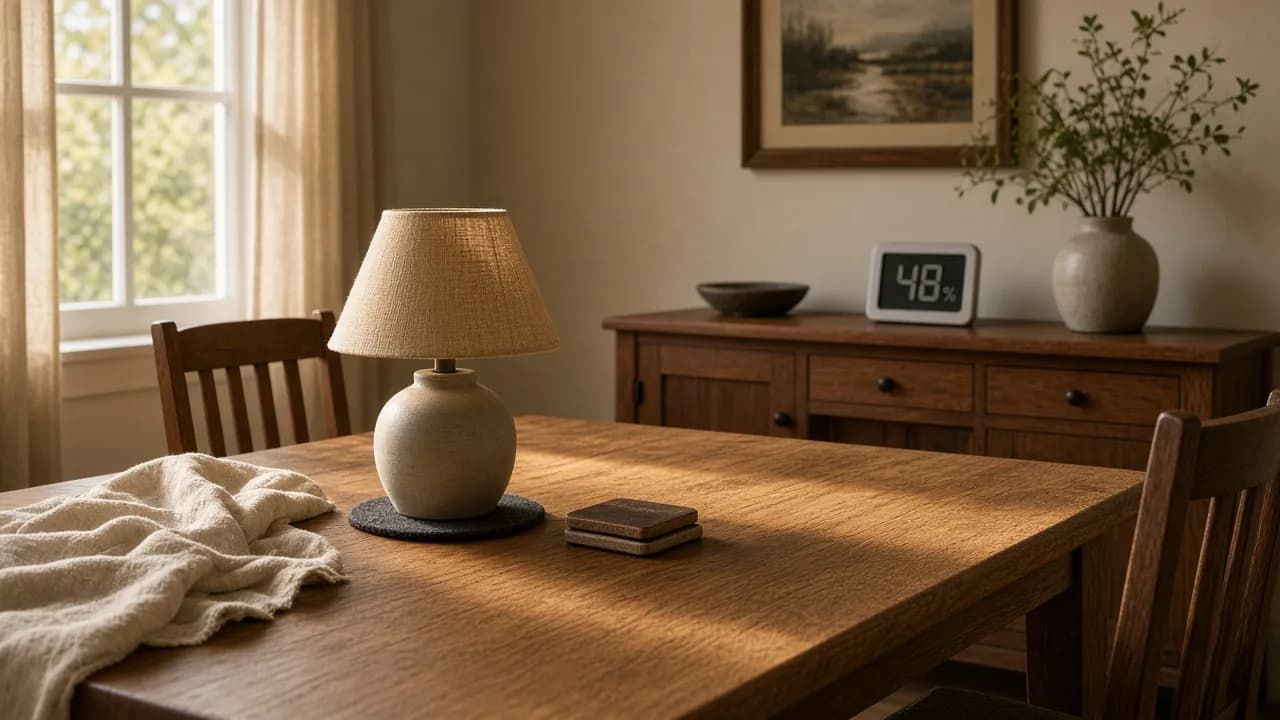
The finish is only as stable as the room. Coasters stop rings. The hygrometer stops the cracks you blame on the maker.
The table did not fail because you skipped a polish. It failed because the furnace dried the room to 20% in January, or a glass sat in a puddle on a July night, or someone sprayed silicone on a finish that was never supposed to be oiled. Those are the three searches behind “wood furniture care,” and they are not the same job. Humidity moves the wood. Water and heat mark the finish. The wrong bottle makes the next repair harder.
Keep the room near 40–50% relative humidity, measure it where the furniture sits, and pull solid wood off vents. Dust with the grain and dry every damp wipe. Do not oil a lacquer or polyurethane top. A white cloudy ring is moisture in the finish and sometimes yields to gentle heat. A black ring has reached the wood — that is a restorer, not a kitchen experiment.
The Humidity Number That Actually Fits a U.S. House
Wood moves until it matches the air. Dry air pulls moisture out and the piece shrinks across the grain. Wet air pushes moisture in and doors grow until they stick. DutchCrafters, walking customers through the complaint they hear most, names humidity first: cabinet doors that suddenly will not close, then the same thing in a dining hutch or a dresser. Their care note is a hygrometer in the house and furniture kept off heating and cooling vents.
Makers and museums do not publish one identical target, and pretending they do is how people over-humidify a Gulf house. Solid-wood shops commonly want about 35–55%, with 40–45% as the quiet middle. Walnut makers often say 40–60%, and they watch tables cup below 30% or swell above 65%. The National Park Service, writing for wooden objects, treats about 50% plus or minus 5 as the national ideal, allows 35–40% in the dry Southwest, and tolerates 55–60% on the coast — then warns that above 70% you are feeding mold, softening glue, and swelling fiber. The U.S. EPA’s home guidance is the ceiling people skip: keep indoor relative humidity in the 30–50% band, and do not run a humidifier past 50%. Condensation on windows is the sign you already overshot.
The number that satisfies both the wood and the mold line is about 40–50%, stable, in the room with the furniture. A whole-house reading in the hallway does not tell you what the dresser against the exterior wall is doing. Louise Beck, conservator at The Henry Ford, allows a seasonal drift if it is slow — warmer, slightly damper summers, a winter floor near 35–45% — and asks that the change not slam the wood by more than about 5% in a day. Chasing 55% with a misting humidifier in a closed bedroom is how you trade a tight drawer for a damp wall.
| Indoor RH | What the wood does | What you do |
|---|---|---|
| Below 30% for weeks | Shrinks, checks, joints open, veneer can lift | Humidify the room; pull furniture off vents. Do not exceed 50%. |
| 40–50% | Small, slow movement. The working target. | Leave it there. Check the hygrometer when the furnace or AC cycles hard. |
| 55–60% | Acceptable on a damp coast if it is stable | Watch windows for condensation. Do not add a humidifier. |
| Above 65% | Swells, drawers stick, finish can cloud | Run AC or a dehumidifier. Keep pieces off damp basement walls. |
EPA home guidance caps humidification at 50% RH. Furniture shops often cite a wider 35–55% band. 40–50% is the overlap.
Winter Heat, Gulf Summers, Desert Air
A single national tip fails because American houses do not share a climate. In the Northeast and Midwest, forced air in November can drop a living room from a comfortable 45% to the high teens in days. That is when a breadboard end on a table pulls, a veneered top crackles, and a customer calls it a defect. The piece was built for indoor air, not for sitting in the plume of a floor register. Move it. Two or three feet off a vent is a start; flush against a radiator is how one side of a case dries faster than the other and the door twists.
Along the Gulf and in the humid Southeast, the threat flips. Outdoor air in summer is often wet enough that an unconditioned room sits at 60–80%. Drawers that slid in April stick in August. A finish can bloom — a cloudy film that is moisture, not dirt. Air conditioning is the dehumidifier. A portable unit in a closed bedroom helps only if you empty it and do not aim the exhaust at the table. Basement apartments need the extra step: do not push a chest flush to a below-grade wall where condensation lives.
Desert and high-plains houses are dry by default. The Park Service treats 35–40% as acceptable there. Forcing a humidifier to 55% in a Phoenix January can put water on the windows while the furniture was fine at 38%. The Pacific Northwest and coastal California are the shoulder-season problem: damp weeks, then a heat pump that dries the room. The tool is the same in every region. A hygrometer you glance at when the weather turns, not a spray you bought because the bottle said “restores.”
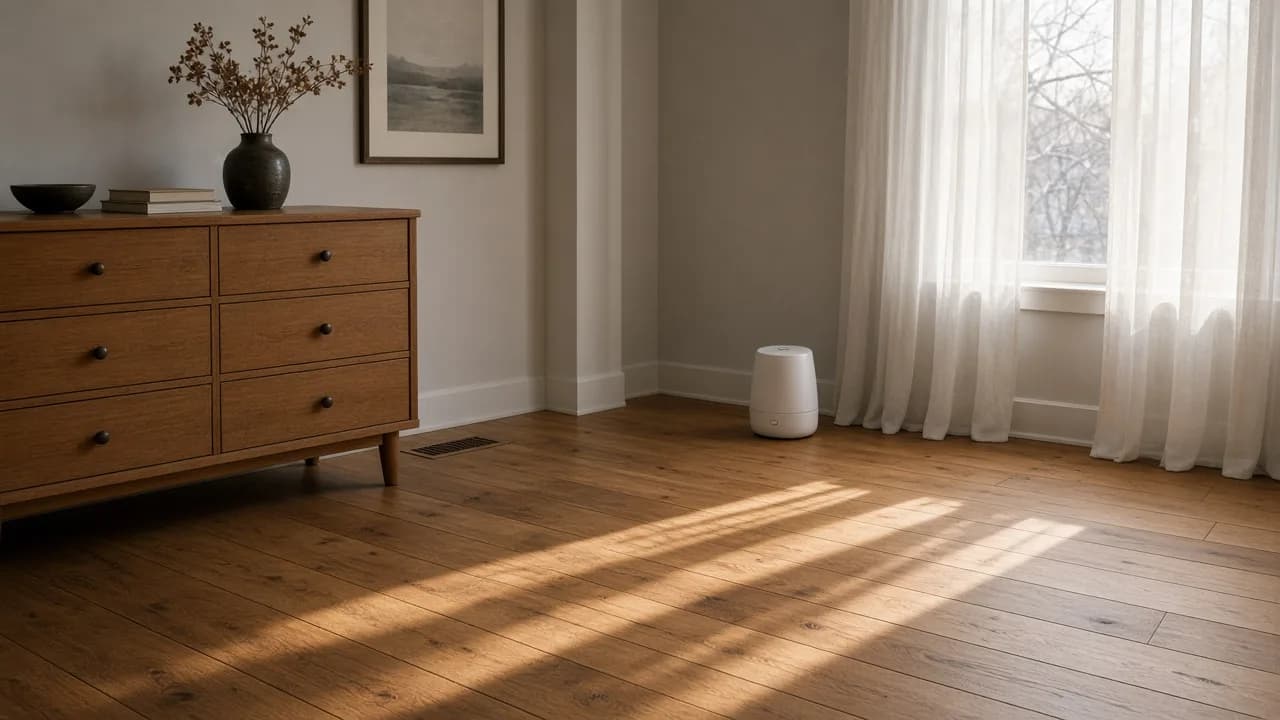
Finish First, Then the Bottle
Most catalog and mid-priced furniture wears a film finish: lacquer, polyurethane, or a catalyzed conversion varnish. The film is what you are cleaning. Oil will not feed the wood through it. It sits on top, stays slightly tacky, and holds dust. Hardwax oil and drying oils are a different surface. They want a refresh measured in years on a dining top — often one to three — not a monthly ritual. If the maker did not name the finish, assume film and do not oil.
Silicone sprays are the habit that looks like care. They shine. Then the shine dulls into a haze, and the silicone is in the finish. Finishers call the cratered repair “fish eye.” Popular Woodworking’s refinishing notes exist because people who polished for a decade cannot get a new coat to lie down. Conservators at The Henry Ford will not bless a mystery commercial polish for that reason: formulas change, and the long effect is hard to see until someone tries to save the piece. DutchCrafters’ shop line is plainer. Clean with a warm, slightly soapy damp rag on a sound varnish. Silicone polish and heavy wax are unnecessary, and waxed finishes are harder for their medics to repair.
| Finish | How to clean | Do not |
|---|---|---|
| Lacquer, polyurethane, conversion varnish | Dust. Barely damp cloth. Dry at once. | Oil, silicone spray, alcohol, standing water |
| Hardwax oil or oil | Dust. Wipe spills fast. Refresh oil every 1–3 years on a used top. | Weekly oiling, silicone, soaking |
| Shellac (many antiques) | Dry dust until a conservator confirms it. | Alcohol, ammonia, vinegar, steam, heat |
| Wax over an old finish | Dust. Thin paste wax rarely, if at all, and buff it off. | Aerosol shine, oil on top of wax buildup |
Daily cleaning is dull on purpose. Cotton or microfiber, with the grain, so grit is not dragged across the film. A cloth wrung almost dry. A drop of mild soap only when the top is actually dirty. Dry the pass before you move on. Do not spray the bottle at the wood — the overspray sits in the joints. Vinegar, ammonia, and alcohol are solvents wearing a kitchen costume. Shellac dissolves in alcohol. Steam and magic erasers cut film you cannot put back.
White Rings, Black Rings, and Heat
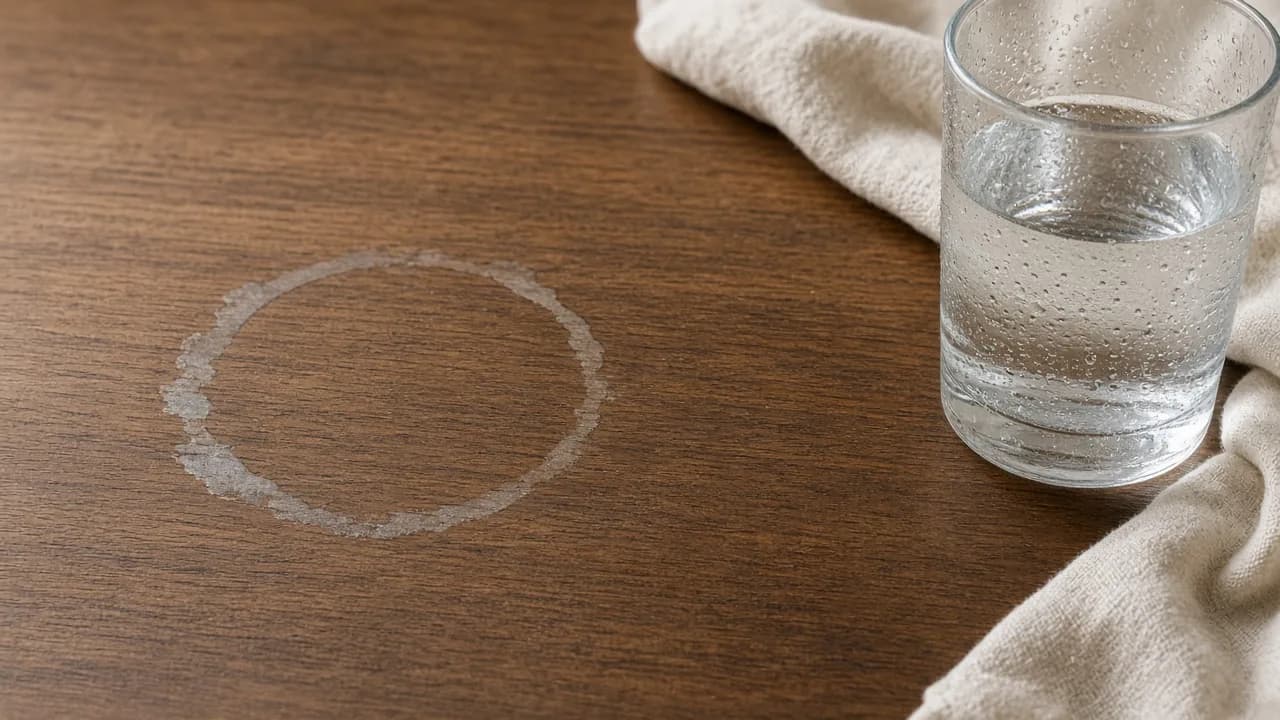
A glass ring and a burnt-in pot mark are not the same stain. DutchCrafters describes the foggy white spot as the finish lifting off the wood when water or heat sits there. Miller’s, writing about conversion varnish, splits the colors the way a restorer does: white means moisture trapped in the finish; black means it has reached the wood. Thomas Johnson, restoring water-damaged tops in Maine, starts from the same household causes — a plant with a useless saucer, a coffee cup — and then does shop work: strip, oxalic acid on the whole surface, rinse, sand, stain, seal. That sequence is how a black ring leaves. It is not a Saturday trick on an intact polyurethane table.
For a fresh white ring on a modern film finish, gentle heat sometimes drives the moisture back out. A hair dryer on low, six to eight inches away, kept moving. Or a warm iron through a dry cotton cloth, a few seconds, then look. Stop if the finish softens, smells, or turns glossier than the rest of the top. Side-by-side tests of mayonnaise, toothpaste, baking soda, and commercial restorers end the same way: a method that clears one finish fails on the next, because the film and how far the water went are different. If you do not know the finish, the honest move is to stop after dry heat and ask the maker or a refinisher. Ironing shellac can melt it. Sanding a white ring into a black one is how a $20 glass becomes a refinish.
Sun, Felt, and the Things You Drag
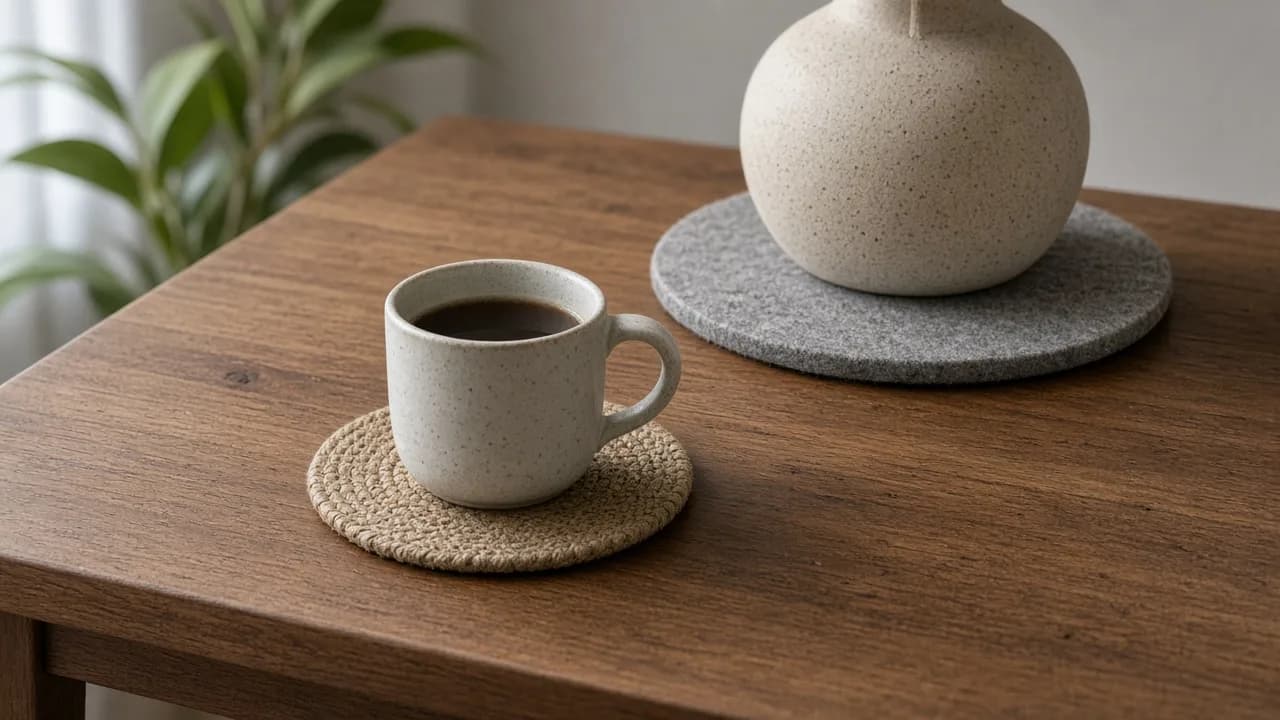
Sun does not crack a table the way a furnace does. It fades and darkens unevenly. Cherry, left in a south window, goes deep red on the exposed half and stays pale under the lamp. Bassett’s care note is blunt about daily exposure, even indirect sun. Sheer curtains during the hard hours, and move the bowl that is printing a pale circle. Felt under lamps, clocks, and the laptop so you lift them instead of skating grit across the top. Plants get a saucer that actually holds water. Thomas Johnson’s water-damage video opens on inadequate saucers for a reason.
- Buy a hygrometer for the room with the wood. Target 40–50%.
- Winter in a heated house: humidify before you polish. Stop at 50%.
- Humid summer or a damp basement: dehumidify or run the AC. Do not add moisture.
- Pull case pieces off vents, radiators, and below-grade walls.
- Name the finish. Film finishes get a damp wipe. Oil finishes get rare oil. Unknown antiques get dust.
- White ring: gentle moving heat, then stop. Black ring: restorer.
- Coasters, trivets, felt, and leaves stored in the same room as the table.
Care is the room, then the finish, then the spill. A Midwest January and a Houston August do not want the same machine running, but they want the same reading on the hygrometer. Polish does not replace that reading. If the piece is already checked, swollen, or black-ringed, fix the air before you pay someone to refinish it into the same dry vent.
Frequently asked questions
What humidity is best for wood furniture?
Aim for about 40–50% relative humidity in the room where the furniture lives. Solid-wood makers often cite 35–55% as the band wood can move in without sticking or cracking. The U.S. EPA tells homeowners not to humidify above 50%, because higher indoor humidity feeds mold and dust mites. Below about 30% for weeks — common in heated northern winters — panels shrink, joints open, and veneer can lift. Above about 65%, drawers swell and finishes can bloom.
Why does wood furniture crack in winter?
Forced-air heat can drop indoor humidity to 15–25% in a matter of days. Wood gives up moisture and shrinks across the grain. That shows up as hairline checks, panel gaps, loose joints, and sticking that suddenly becomes a rattle. A room humidifier, furniture pulled off the vent, and a hygrometer you actually look at fix more winter cracks than any polish.
How do you remove a white water ring from a wood table?
A white or cloudy ring is usually moisture or heat trapped in the finish, not a stain in the wood. Blot fresh spills. For a set ring, try a hair dryer on low, 6–8 inches away, moving constantly, or a warm — not hot — iron through a dry cotton cloth for a few seconds at a time. Stop if the finish softens or smells. What works on one finish fails on another. If the ring is black, or the finish is shellac, antique, or unknown, stop and ask a restorer. Sanding and oxalic acid are shop work after the finish is off.
Should I use furniture polish or Pledge on wood?
Not as a habit. Most aerosol “wood care” sprays contain silicone. They shine for a week, then leave a film that holds dust. Silicone also migrates into the finish and causes fish-eye craters if anyone tries to refinish later. DutchCrafters’ furniture shop tells customers silicone polish and heavy wax are unnecessary on a sound conversion varnish, and easier to repair if you never waxed it. Dust, a barely damp cloth, and humidity do more than lemon oil on a film finish.
Can I oil a lacquer or polyurethane table?
No. Oil soaks into an oil or hardwax-oil finish. On lacquer, polyurethane, or conversion varnish it sits on the film, stays tacky, and collects grime. Hardwax-oil dining tops are typically refreshed every one to three years, not every month. If you do not know the finish, do not oil it. Ask the maker, or test a hidden edge only if you are willing to live with a dark spot there.
How do you clean wood furniture without damaging the finish?
Dust with the grain using cotton or microfiber. For a sealed modern finish, wring a cloth until it is barely damp, add a drop of mild dish soap only if the surface is grimy, wipe, then dry immediately. Do not spray cleaner onto the wood. Skip vinegar, ammonia, alcohol, steam, and magic erasers. Shellac dissolves in alcohol. Unidentified antiques get dry dusting until a conservator names the finish.
Does wood furniture care change in humid states?
Yes. Gulf and Southeast summers can hold indoor humidity at 60–80% if the air conditioner is off. That swells doors and drawers and can cloud a finish. Run the AC or a dehumidifier and keep pieces off damp basement walls. Desert and high-plains winters are the opposite problem: dry air, not mold. Northeast and Midwest homes often swing from both — wet summers and furnace-dry winters — so the hygrometer matters more than a single seasonal product.
How long should new wood furniture acclimate?
Give a solid-wood piece one to two weeks in the room where it will live before you decide a sticky drawer is a defect. Wood equalizes to the new humidity. Store extra table leaves in that same room. A leaf left in a garage or damp basement will not match the top when you need it, and forcing it can split the joint.
- wood furniture care
- how to care for wood furniture
- wood furniture humidity
- white water ring on wood
- how to clean wood furniture
- furniture polish
- oil vs lacquer finish
- wood furniture cracking
Related guides
- Dining Table Size Guide: How to Choose the Right Size for Your Room
A practical, measurement-first guide to dining table size, with seating charts, clearance rules, and the room math that tells you exactly how big you can go.
- Furniture Delivery Day Checklist: What to Inspect Before You Sign
A field checklist for U.S. furniture delivery day — service levels from curb to white-glove, ROC explained, inspection steps before you sign, and how to protect a damage claim.
- Outdoor Furniture Materials by Climate: Teak, Aluminum, HDPE & More
Match patio furniture materials to your U.S. climate — teak, powder-coated aluminum, HDPE lumber and wicker, solution-dyed cushions, and hardware that lasts.